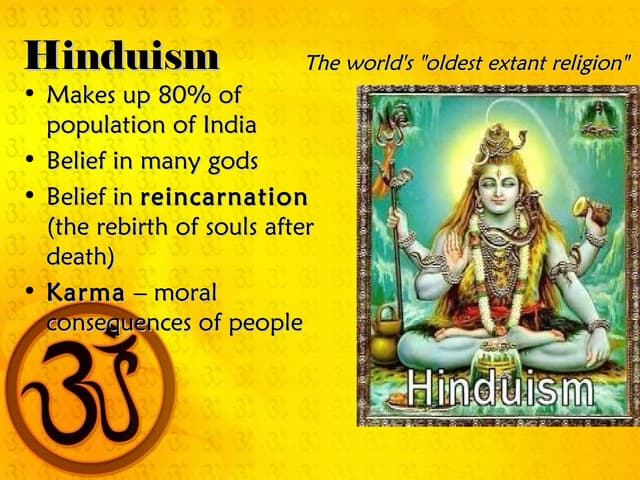
 Hinduism is the world’s oldest major religion, a diverse collection of traditions originating in India with no single founder or central authority but unified by shared concepts like dharma, karma, and reincarnation. It involves worship of various deities seen as manifestations of a supreme reality, Brahman, and uses sacred texts such as the Vedas and Upanishads to guide followers toward spiritual liberation. The term “Hinduism” emerged in the 19th century.
 “In the vast expanse of Vedic cosmology, time is seen as cyclical, unlike the linear perspective prevalent in Western cultures. According to the Vedas, the universe undergoes an eternal cycle of four cosmic ages known as Yugas: Satya, Treta, Dvapara, and Kali. Each Yuga marks a distinct phase in the spiritual and moral development of humanity. Among these, Kali Yuga, the last and darkest of the ages, is often referred to as the Iron Age or the Dark Age.
Yuga cycles are a Hindu cosmological concept of time as a cycle of four World ages of Satya Yuga, Treta Yuga, Dvapara Yuga, and Kali Yuga. Each Yuga repeats indefinitely and represents a gradual decline in spiritual consciousness, longevity, and virtue, with the cycle lasting 4,320,000 human years.
-
-
Satya Yuga (Golden Age):
The age of highest spiritual development and truth, where virtue, dharma, and spiritual knowledge are at their peak.
-
Treta Yuga (Silver Age):
The age where spiritual life begins to decline, and virtue diminishes.
-
Dvapara Yuga (Bronze Age):
Characterized by the further emergence of suffering, spiritual decay, and a more significant loss of Vedic knowledge.

-
-
Kali Yuga (Iron Age):The most degenerate age, marked by ignorance, materialism, a considerable loss of virtue, and widespread spiritual decline.Kali Yuga, the darkest of the four Yugas, presents a grim picture of humanity’s decline. The Vedic scriptures provide this cyclical view of time as a reminder of the transient nature of existence and the importance of spiritual discipline. Understanding the symptoms and characteristics of Kali Yuga serves as a call to strive for righteousness, even in the face of adversity and moral decay. As we navigate through this age, the teachings of the Vedas offer guidance and hope for eventual renewal and enlightenment.”