“As a classic of Taoist thought, The Art Of War explains the way in which ‘power is continually tempered by a profound undercurrent of humanism.’ It reveals the fundamentals of Taoism which teaches that life is a complex of interacting forces. One should strive to encourage balance in the understanding of mass psychology.
The most prestigious and influential book on strategy and dealing with conflict, The Art Of War, teaches that aggression and response in kind can lead only to destruction—we must learn to work with conflict in a more profound and effective way. Crucial to this strategic vision is knowledge—especially self-knowledge—and a view of the whole that seeks to bring the conflicting ideas around to a larger perspective.
As Sun Tzu  teaches, ‘I have three treasures that I keep and prize: one is kindness, second is frugality, and third is not presuming to take precedence over others. By kindness one can be brave, by frugality one can reach out, and by not presuming to take precedence one can survive effectively. If one gives up kindness and courage, gives up frugality and breadth, and gives up humility for aggressiveness, one will die. The exercise of kindness in battle leads to victory, the exercise of kindness in defense leads to security.’
The Art Of War goes on to emphasize the central importance of deception: ‘A military operation involves deception. Even though you are competent, appear incompetent. Though effective, appear ineffective.’ As the Tao-te Ching emphasizes, ‘One with great skill appears inept.’ The element of surprise, so important for victory with maximum efficiency, depends on knowing others while being unknown to others, so secrecy and misdirection are considered essential arts.
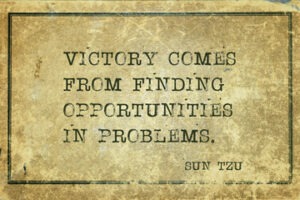
Master Sun affirms that it is best to win without fighting. In his The Art Of War, he details the tactics of ancient Chinese armies. Its aim is invincibility, victory without battle, and unassailable strength through an understanding of the physics, politics, and psychology of conflict.”