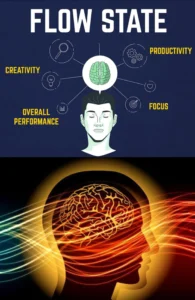
“One of the most fascinating discoveries in psychology comes from Mihaly Csikszentmihalyi, who spent decades studying what he called ‘Flow.’
Flow is a mental state where a person becomes so deeply engaged in an activity that everything else fades away. People often describe it like this:
• time seems to disappear
• the mind becomes completely focused
• actions feel effortless and natural
• self-doubt and overthinking vanish
Athletes call it ‘being in the zone.’ Artists describe it as creative immersion. Scientists sometimes call it optimal performance. But psychologically, something very interesting is happening. During flow, the part of the brain responsible for self-conscious thinking—the ego-driven narrative mind—becomes quieter. Instead of constantly analyzing and judging, the brain allows action and awareness to merge. This phenomenon is sometimes called ‘transient hypofrontality,’ where the prefrontal cortex (the area responsible for self-monitoring and overthinking) temporarily reduces its activity.
When that happens, the brain becomes:
⚡ more creative
⚡ more focused
⚡ more efficient
⚡ more intuitive
In other words, the mind is no longer fighting itself. Many people describe flow as a mini awakening, because for a moment the constant inner commentary disappears and what remains is pure presence with the task at hand.
 Flow can happen during many activities, including:
• playing music
• writing or creating art
• sports or physical movement
• solving complex problems
• building or designing something
• deep study or learning

The key ingredients that create flow are surprisingly consistent:
✔ a clear goal
✔ a challenge that matches your skill level
✔ full concentration on the task
✔ immediate feedback from what you’re doing
When these conditions are present, the brain naturally shifts into this state. One of Csikszentmihalyi’s most important discoveries was that people are happiest not when they are relaxing, but when they are in flow.
Why? Because flow creates a sense of meaning, progress, and deep engagement with life. It’s a reminder that fulfillment often comes not from escaping effort—but from fully immersing ourselves in something that matters to us. Sometimes the most profound moments of clarity don’t come from searching for answers. They come from becoming so present in what we’re doing that the mind finally gets out of its own way.”
Amalia Lynn Kovach